

From a Helpful Tool to a Development Partner
The web development industry is experiencing one of the most significant transformations in its history, driven by the rapid advancement of artificial intelligence. For decades, building websites relied almost entirely on human expertise across planning, design, development, testing, and maintenance. Today, AI has become an active participant in many of these stages.
In just a few years, artificial intelligence has evolved from an emerging technology used in specialized applications into a core component of modern digital workflows. Developers, designers, businesses, and website owners are increasingly integrating AI-powered tools into their daily operations, reshaping how digital products are built and managed.
The question is no longer whether AI will influence web development. The real question is how deeply it will redefine the future of websites, digital experiences, and the role of development teams.
Why Artificial Intelligence Has Become a Major Industry Driver
Every major phase in the evolution of the web has been defined by tools that improved productivity and reduced complexity. Content management systems simplified publishing. Frameworks accelerated development. Cloud computing transformed infrastructure management.
Artificial intelligence represents a different kind of shift.
Instead of simply providing another tool for developers, AI is changing how work itself is performed. Tasks that once required hours of manual effort can now be completed in minutes with the assistance of intelligent systems capable of understanding context, generating code, identifying issues, and offering recommendations.
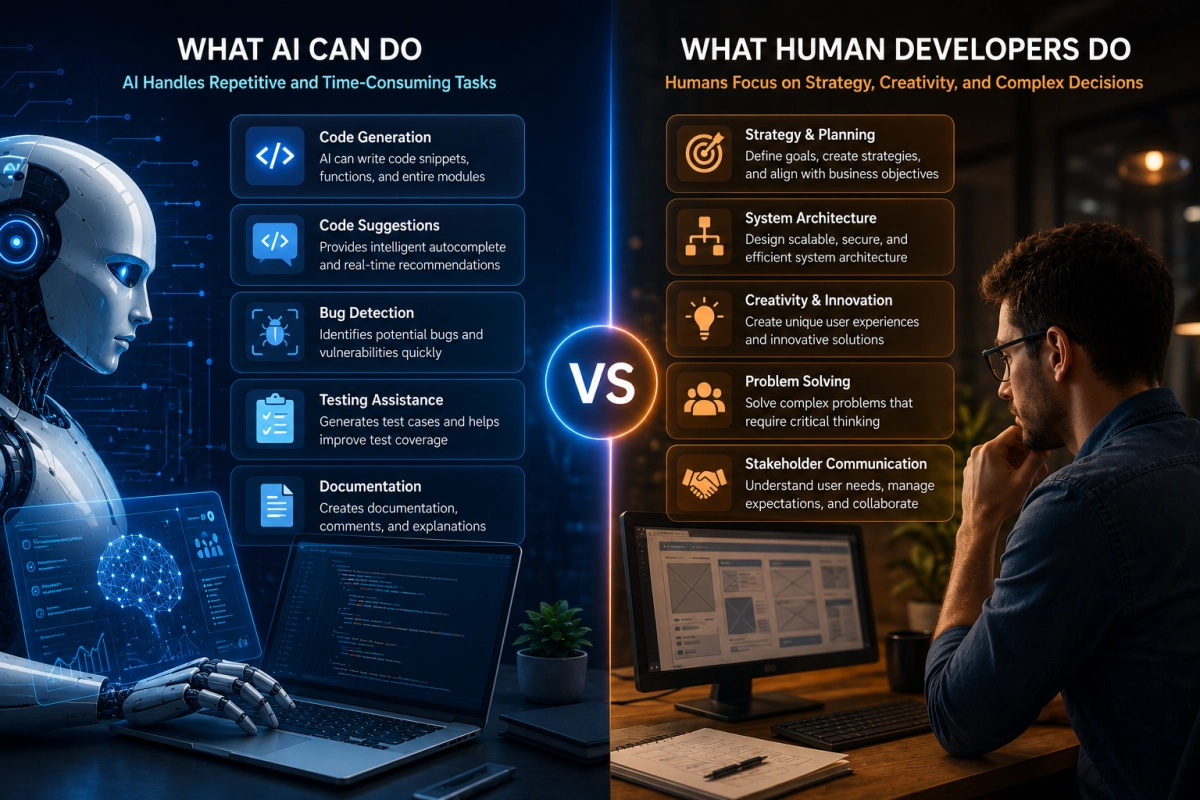
As a result, development teams can spend less time on repetitive implementation work and more time focusing on strategy, architecture, problem-solving, and innovation. This explains why technology companies around the world are investing heavily in AI-powered development platforms and coding assistants.
How AI Is Reshaping the Web Development Lifecycle
The impact of artificial intelligence extends far beyond writing code. It is influencing nearly every stage of the website development process.
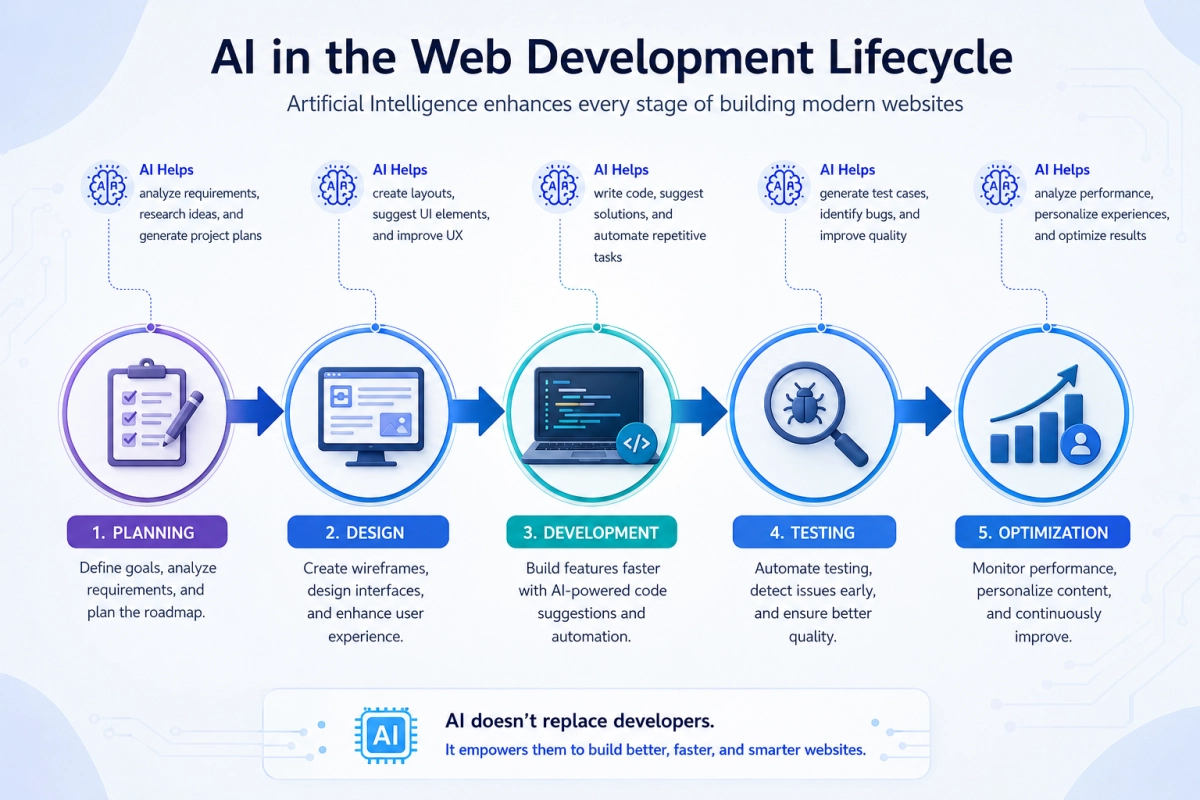
Planning and Requirements Analysis
Successful digital projects begin with understanding business objectives and translating ideas into actionable requirements.
Modern AI systems can assist in the early planning phase by analyzing project descriptions, suggesting feature sets, generating documentation, and helping teams organize requirements more efficiently.
While human expertise remains essential for understanding business goals and user expectations, AI can significantly accelerate the initial planning process and provide valuable starting points for project teams.
User Interface and User Experience Design
Artificial intelligence is also transforming the design process.
Many modern design tools can generate layouts, wireframes, and interface concepts based on simple text prompts. Some platforms can even analyze user behavior and recommend design improvements aimed at increasing engagement and conversion rates.
Human creativity remains irreplaceable in design, but AI is becoming a powerful collaborator that helps designers move from concept to prototype much faster than before.
Development and Coding
Software development is arguably the area where AI has had the most visible impact.
Modern AI-powered coding assistants can generate code, explain functions, suggest improvements, identify bugs, and help developers navigate complex codebases. They can automate repetitive programming tasks and reduce the time required to build features.
However, the true value of these tools is not replacing developers. Instead, they enable developers to focus on higher-value activities such as architecture, optimization, security, and business logic.
Testing and Quality Assurance
Testing has traditionally been one of the most time-consuming phases of software development.
AI is helping teams automate portions of the testing process by generating test scenarios, analyzing results, identifying patterns, and detecting potential issues before they affect end users.
Although human oversight remains essential, intelligent testing tools are making quality assurance faster and more efficient.
What This Means for Businesses and Website Owners
The impact of AI is not limited to developers.
Businesses and organizations are benefiting from faster development cycles, more efficient workflows, and improved decision-making capabilities. Companies can launch prototypes more quickly, implement changes faster, and reduce some of the operational bottlenecks that traditionally slow down digital projects.
Artificial intelligence is also becoming increasingly valuable after a website goes live.
Today, AI can help organizations:
- Analyze visitor behavior.
- Improve user experiences.
- Personalize content delivery.
- Support customers through intelligent assistants.
- Monitor website performance.
- Detect potential issues before they become critical.
In other words, AI contributes not only to building websites but also to operating and improving them over time.
From Traditional Websites to Intelligent Digital Experiences
The role of websites is evolving.
In the past, websites primarily served as information hubs or online service platforms. Today, organizations are focused on creating intelligent digital experiences that adapt to user needs and expectations.
This shift has led to increased adoption of:
- AI-powered recommendation engines.
- Intelligent chatbots.
- Natural language search systems.
- Personalized content experiences.
- Real-time analytics and optimization.
As these technologies continue to mature, websites will become increasingly capable of understanding user intent and delivering highly relevant experiences automatically.
Will Artificial Intelligence Replace Web Developers?
One of the most common concerns surrounding AI is whether it will eventually replace software developers.
While AI can already generate code, automate tasks, and solve certain technical problems, web development involves much more than writing software.
Successful digital products require:
- Strategic thinking.
- Business understanding.
- System architecture.
- Creative problem-solving.
- Risk management.
- Communication and collaboration.
These responsibilities still depend heavily on human expertise.
Rather than eliminating developers, AI is likely to transform their role. Developers will increasingly act as architects, reviewers, strategists, and supervisors of intelligent systems rather than focusing exclusively on manual implementation.
The most successful professionals will be those who learn how to work alongside AI rather than compete against it.
Challenges and Risks
Despite its advantages, artificial intelligence introduces important challenges that organizations must address.
Quality and Reliability
AI-generated outputs can appear correct while still containing logical flaws, performance issues, or implementation mistakes. Human review remains critical.
Security Concerns
Poorly generated code or unsafe implementation practices can introduce security vulnerabilities if developers rely on AI without proper validation.
Data Privacy
Many AI platforms operate through cloud-based services, raising important questions regarding confidentiality, intellectual property, and data protection.
Overdependence on Automation
Teams that rely too heavily on AI without maintaining strong technical foundations risk weakening their problem-solving capabilities and technical expertise over time.
The Future of Web Development
Current trends suggest that artificial intelligence will become a standard component of modern development environments.
Over the coming years, we are likely to see:
More Autonomous AI Agents
AI systems will become increasingly capable of handling complex workflows and completing multi-step development tasks with minimal supervision.
Highly Personalized Websites
Digital platforms will adapt content, interfaces, and experiences dynamically based on individual user behavior.
Data-Driven Decision Making
Development strategies will rely more heavily on real-time analytics and intelligent insights.
Faster Innovation Cycles
As routine work becomes increasingly automated, development teams will have more time to focus on innovation, experimentation, and product improvement.
Conclusion
Artificial intelligence represents one of the most important shifts in the history of web development.
Its significance extends beyond generating code or accelerating workflows. AI is changing how websites are planned, designed, developed, managed, and optimized. It is enabling businesses to move faster, developers to work more efficiently, and digital platforms to become smarter and more adaptive.
However, technology alone is not the determining factor of success.
The organizations and professionals that thrive in the coming years will not simply be those using AI. They will be the ones who understand how to combine human expertise, strategic thinking, and intelligent automation to build better digital products and deliver greater value to users.
The future of web development will not be defined by humans or artificial intelligence alone. It will be shaped by the collaboration between both.