

An Industry Facing One of the Biggest Shifts in Its History
The media industry has never been isolated from technological change. From printed newspapers to online publishing, and from traditional broadcasting to digital platforms, journalism has continuously evolved alongside new technologies and changing audience behaviors.
However, the transformation taking place today is fundamentally different.
With the rapid advancement of artificial intelligence, media organizations around the world are rethinking how content is created, managed, distributed, and analyzed. AI-powered technologies are becoming increasingly integrated into newsrooms, publishing platforms, audience analytics systems, and digital marketing operations.
The conversation is no longer about whether media organizations should use artificial intelligence. The real question is how they can use it effectively while maintaining accuracy, credibility, and editorial standards.
In an environment where competition for audience attention is more intense than ever, the ability to leverage intelligent technologies is becoming a key factor in determining which media organizations will thrive in the years ahead.

How Artificial Intelligence Entered the Newsroom
The earliest applications of AI in journalism were relatively limited, focusing on simple automation tasks and data processing.
As machine learning systems and large language models evolved, their role expanded significantly.
Today, many media organizations use AI-assisted tools to support:
- Research and information gathering.
- Data analysis.
- Report summarization.
- Draft generation.
- Translation.
- Trend monitoring.
- Search engine optimization.
- Audience analytics.
While the level of adoption varies between organizations, the overall trend is clear: artificial intelligence is becoming a standard component of modern newsroom operations.
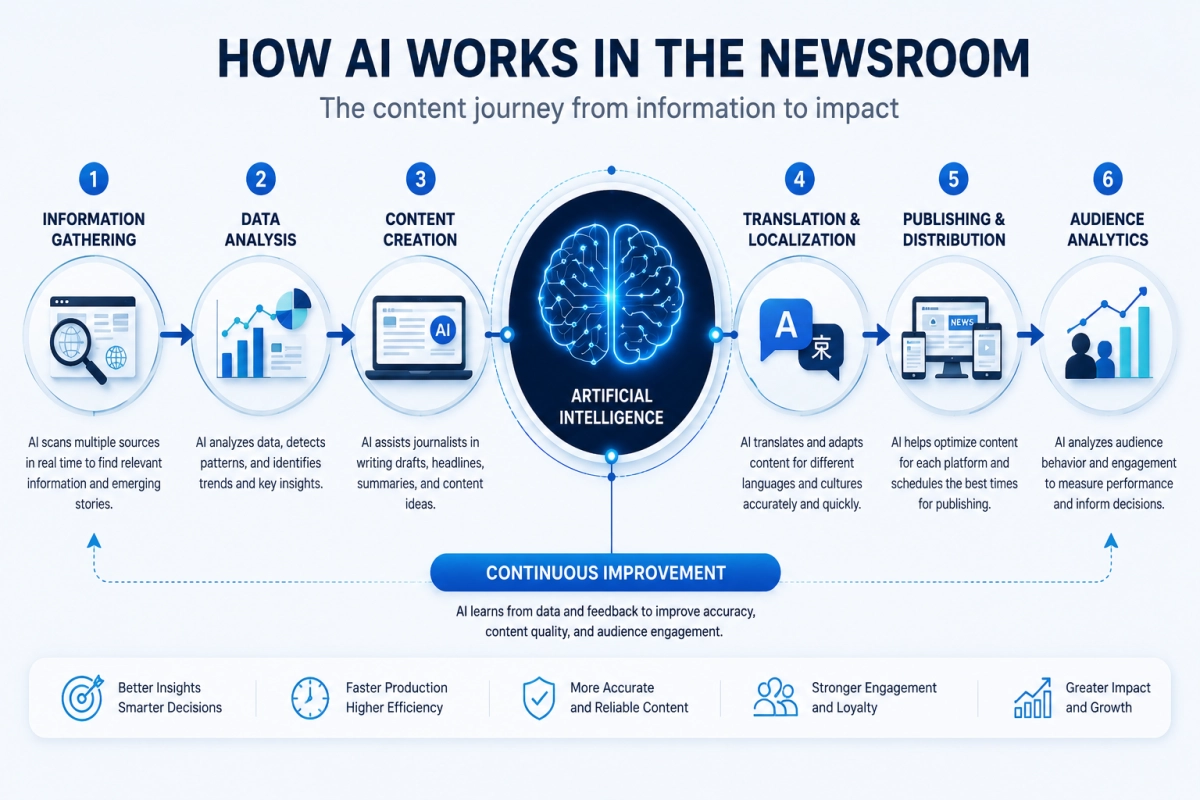
How AI Is Being Used in Digital Media
The impact of artificial intelligence extends across the entire content production workflow.
Research and Information Gathering
Research is one of the most time-consuming aspects of journalism.
AI-powered systems can help journalists identify relevant sources, analyze large volumes of information, and organize data more efficiently.
This enables media professionals to spend less time searching and more time verifying, investigating, and producing high-quality stories.
However, verification and fact-checking remain essential human responsibilities.
Summarizing Reports and Documents
Newsrooms often deal with lengthy reports, studies, financial documents, and official statements.
Artificial intelligence can quickly generate summaries that help editors and journalists identify key insights and important developments.
This capability significantly improves workflow efficiency, particularly when covering complex topics.
Content Production
AI tools can assist in generating article drafts, headlines, descriptions, newsletters, and content ideas.
Professional media organizations rarely publish AI-generated content without review. Instead, these tools are typically used to accelerate the initial stages of content creation while maintaining human editorial oversight.
Multilingual Publishing and Translation
As digital audiences become increasingly global, translation has become a critical component of content strategy.
Artificial intelligence can dramatically reduce translation time and help publishers distribute content across multiple languages and markets.
Human review remains important to ensure accuracy, context, and cultural relevance.
Search Engine Optimization
Organic traffic remains a major source of visitors for many news websites.
AI-powered SEO tools help publishers identify keyword opportunities, optimize headlines, improve content structure, and discover emerging search trends.
These capabilities contribute to stronger visibility and improved audience reach.
Audience Analysis
Understanding audience behavior has become a major competitive advantage in digital publishing.
Artificial intelligence enables media organizations to analyze user interactions, identify engagement patterns, and gain deeper insights into reader preferences.
These insights help guide editorial decisions and improve content strategies.
How AI Is Changing News Websites
Modern news websites face growing challenges, including increased competition, shorter attention spans, and rapidly changing audience expectations.
Artificial intelligence is helping publishers address many of these challenges.
On the operational side, AI can streamline repetitive tasks and accelerate publishing workflows.
On the strategic side, it provides advanced tools for performance analysis, audience segmentation, content personalization, and recommendation systems.
Many publishers are now implementing intelligent recommendation engines that display relevant content based on reader interests and browsing behavior, helping increase engagement and retention.
Opportunities for Publishers and Media Organizations
Organizations that treat artificial intelligence as a productivity tool rather than a replacement for human expertise are discovering significant opportunities.
Faster Content Production
Speed is often critical in modern journalism.
AI helps reduce the time required for research, organization, drafting, and data processing, allowing journalists to focus on reporting, analysis, and storytelling.
Greater Operational Efficiency
Media companies face increasing pressure to optimize resources and manage costs.
By automating repetitive workflows, AI can improve efficiency while allowing editorial teams to dedicate more attention to high-value activities.
Expanded Audience Reach
Through translation, personalization, and audience analysis, publishers can connect with broader and more diverse audiences.
This creates new opportunities for growth and engagement.
Improved User Experience
The success of digital media platforms increasingly depends on user experience.
AI-powered recommendation systems, search functionality, and content personalization help create more relevant and engaging experiences for readers.
Challenges and Risks
Despite its advantages, artificial intelligence introduces important challenges that cannot be ignored.
Accuracy and Reliability
AI systems can generate convincing content that contains factual inaccuracies or misleading information.
This makes editorial review and verification more important than ever.
Loss of Context
Journalism is not simply about producing text.
It involves understanding social, political, economic, and cultural contexts. AI systems often struggle with these deeper layers of interpretation.
Misinformation and Low-Quality Content
The ability to generate content at scale increases the risk of misinformation, low-quality publishing, and automated content abuse.
Responsible editorial policies are essential to prevent these risks.
Privacy and Intellectual Property
Questions surrounding copyright, training data, ownership rights, and privacy continue to shape discussions about AI adoption across the media industry.
These issues are likely to remain central topics in future regulatory and legal debates.
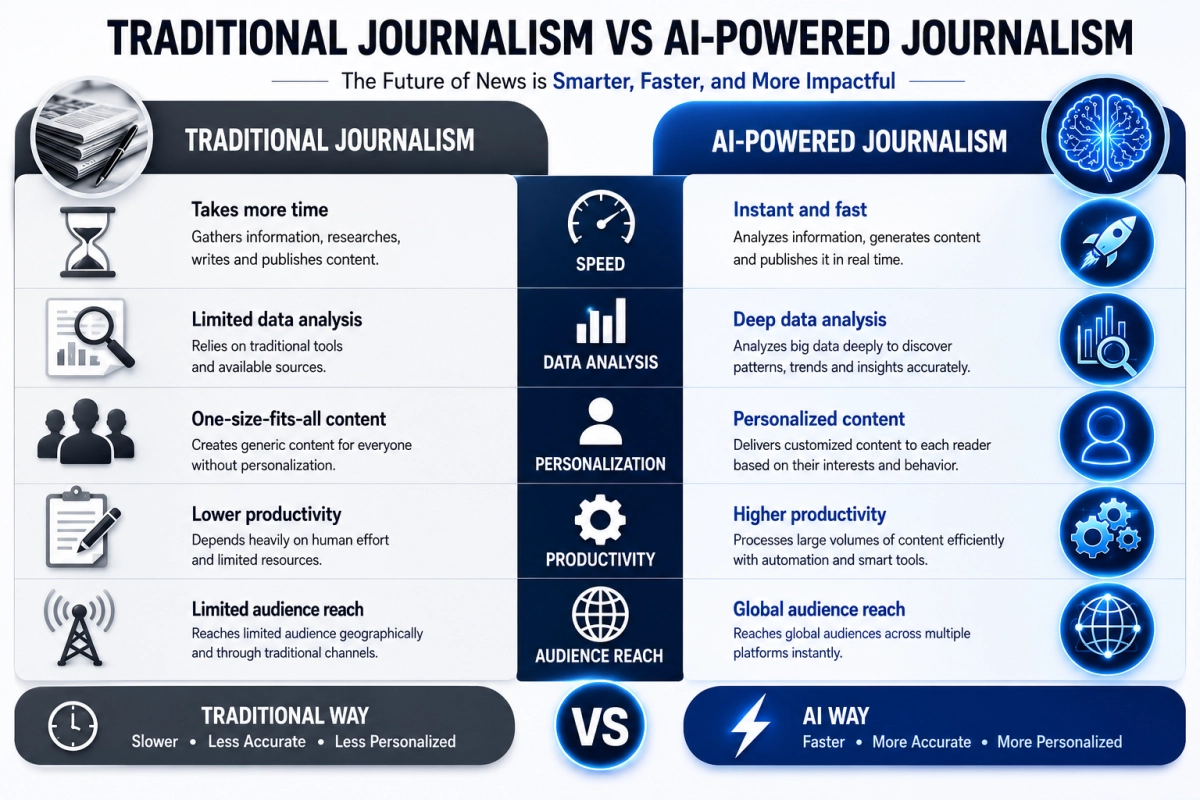
Will AI Replace Journalists?
This is perhaps the most frequently asked question surrounding artificial intelligence in media.
While AI can assist with writing, research, and analysis, journalism involves far more than content generation.
Professional journalists are responsible for:
- Fact-checking.
- Source development.
- Interviews.
- Investigative reporting.
- Contextual analysis.
- Editorial decision-making.
These responsibilities require judgment, experience, ethics, and critical thinking.
Rather than replacing journalists, AI is more likely to change how they work.
Those who learn to use AI effectively will gain productivity advantages, while those who ignore these technologies may struggle to remain competitive.
The Future of Digital Media
Current trends suggest that the relationship between journalism and artificial intelligence will continue to deepen.
Several developments are likely to shape the future of digital publishing.
Data-Driven Newsrooms
Editorial decisions will increasingly rely on real-time audience data and predictive analytics.
Personalized Content Experiences
Readers will receive more customized content based on their interests, behaviors, and preferences.
Smarter Editorial Tools
AI-powered assistants will help journalists review content, identify errors, improve clarity, and optimize performance.
Cross-Platform Content Distribution
Publishers will become more efficient at repurposing and distributing content across multiple channels and formats.
Greater Importance of Human Expertise
As automation handles routine tasks, human strengths such as creativity, investigation, critical thinking, and trust-building will become even more valuable.

Conclusion
Artificial intelligence represents one of the most significant transformations in the history of digital media.
It offers powerful opportunities to improve efficiency, accelerate production, enhance audience understanding, and create better user experiences. At the same time, it introduces new challenges related to accuracy, credibility, ethics, and responsibility.
The future is unlikely to be defined by a competition between journalists and artificial intelligence.
Instead, it will be shaped by collaboration between human expertise and intelligent technology.
Media organizations that successfully combine innovation, editorial integrity, and technological adaptability will be best positioned to lead the next generation of digital journalism.