

Many business owners believe that launching a website is the final milestone in their digital journey. Once the website goes live, they expect visitors, leads, and results to follow automatically.
In reality, the opposite is often true.
Every year, thousands of new websites are launched, yet a large percentage fail to achieve their goals within the first few months. Some stop receiving updates, others struggle to attract visitors, and many eventually become inactive digital assets that contribute little to the business.
The problem is rarely the website itself.
Most failures occur because there is no clear strategy for what happens after launch. A successful website is not defined by the day it goes live, but by how it is managed, improved, and developed over time.
Mistake #1: Treating Launch Day as the Finish Line
One of the most common mistakes is believing that the project ends when the website is published.
In reality, launch day marks the beginning of the most important phase.
After launch, businesses must focus on:
- Content creation.
- Search engine optimization.
- User behavior analysis.
- Service and page improvements.
- Ongoing user experience enhancements.
Websites that stop evolving after launch often lose their value regardless of how impressive they initially looked.
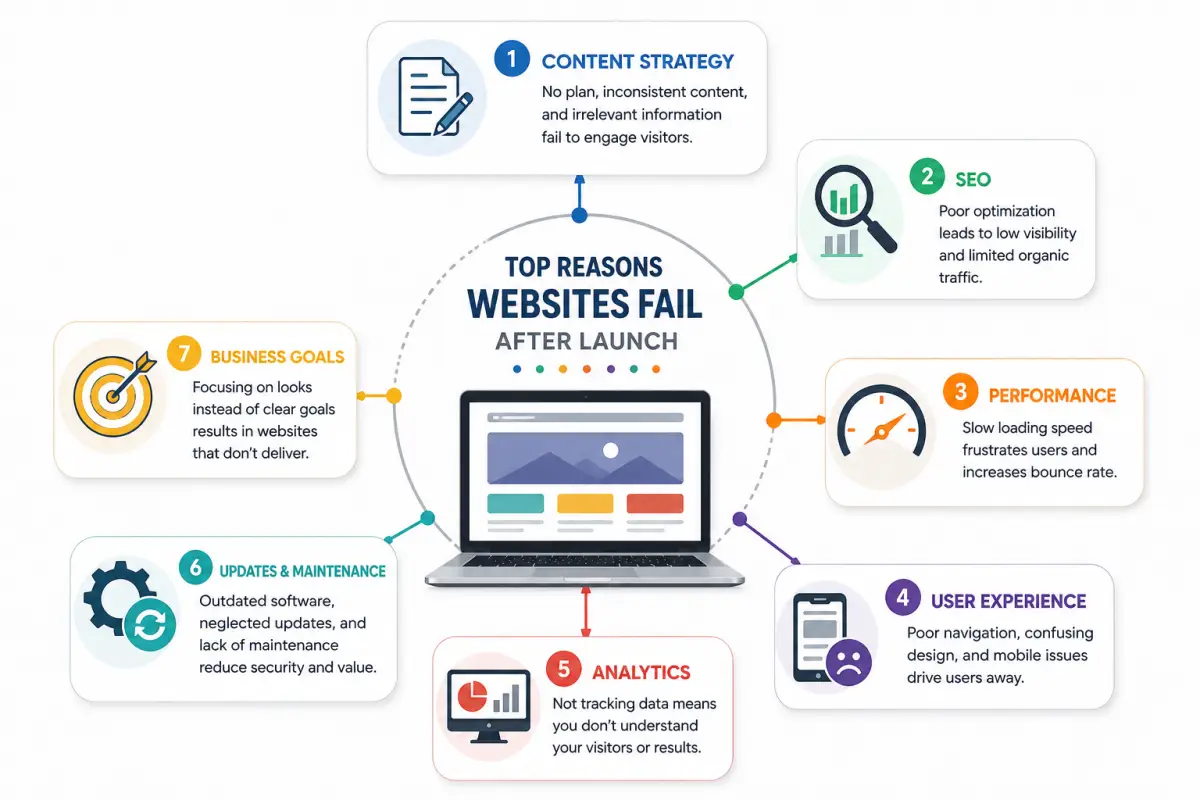
Mistake #2: Having No Content Strategy
Even the most visually appealing website will struggle if it lacks useful and relevant content.
Successful websites consistently provide value to their audiences by answering questions, solving problems, and delivering information that users actually need.
Common content-related problems include:
- Inconsistent publishing.
- Prioritizing quantity over quality.
- Ignoring audience needs.
- Publishing repetitive content with little value.
Without a content strategy, both users and search engines gradually lose interest.
Mistake #3: Ignoring Search Engine Optimization
Many businesses launch a website and simply hope that visitors will find it.
Unfortunately, online competition is stronger than ever.
Achieving visibility in search results requires continuous effort, including:
- Optimized page structures.
- Keyword research.
- Website speed improvements.
- High-quality content.
- Effective internal linking.
Without SEO, even a well-designed website may struggle to attract consistent traffic.
Mistake #4: Poor Performance and User Experience
Visitors have limited patience.
If a website loads slowly, performs poorly on mobile devices, or creates unnecessary friction, users are likely to leave before engaging with the content or services.
Common performance issues include:
- Slow loading times.
- Overloaded pages.
- Weak mobile experience.
- Difficult navigation.
Performance and usability are no longer optional. They are critical factors in website success.
Mistake #5: Failing to Measure Results
It is impossible to improve what you do not measure.
Yet many websites operate for months or even years without meaningful performance tracking.
Businesses should monitor:
- Website traffic.
- Traffic sources.
- Top-performing pages.
- Conversion rates.
- User behavior.
These insights help guide informed decisions instead of relying on assumptions.
Mistake #6: Neglecting Continuous Improvement
The digital landscape changes constantly.
What worked two years ago may no longer be effective today.
Successful websites continuously evolve through:
- Design updates.
- Performance optimization.
- New feature development.
- Technical maintenance.
- Adapting to changing user expectations.
Websites that stop improving often fall behind competitors.
Mistake #7: Focusing on Appearance Instead of Purpose
A website can look beautiful while still failing to deliver results.
Success is not measured solely by design quality. It is measured by how effectively the website supports business objectives.
Every business should ask:
- Does the website generate leads?
- Does it support customer communication?
- Does it build trust?
- Does it contribute to sales or growth?
If the answer is no, the problem is not necessarily the design—it may be the lack of a clear strategy.
How to Build a Website That Continues to Grow
Successful websites tend to share several important characteristics.
Clear Goals
Every website should have clearly defined objectives from the start.
Consistent Content
Content remains one of the strongest drivers of long-term growth.
Search Engine Optimization
Organic search visibility creates sustainable traffic opportunities.
Continuous Analysis
Data-driven decisions lead to better outcomes than assumptions.
Ongoing Development
A successful website is never truly finished. It evolves alongside the business and its audience.
Conclusion
Many websites fail after launch because businesses treat the launch itself as the destination rather than the beginning of the journey.
A successful website requires continuous content creation, ongoing optimization, performance monitoring, and strategic development.
Ultimately, website success is not determined by how attractive it looks, but by how effectively it creates value for users and supports business goals over the long term.
The websites that continue to grow are the ones that are actively managed, continuously improved, and aligned with the needs of both their audience and their organization.