

One of the first questions businesses face when planning a new website is whether to build it with WordPress or invest in a fully custom-developed solution.
Although this may seem like a technical decision, it directly affects project costs, launch speed, scalability, maintenance requirements, and long-term growth opportunities.
Over the years, WordPress has become the most widely used platform for building websites, while custom development remains the preferred choice for projects with unique requirements and advanced functionality.
So which option is better?
The answer depends entirely on the goals, complexity, budget, and future vision of your project.
What Is WordPress?
WordPress is an open-source content management system that allows businesses and individuals to build and manage websites without developing every feature from scratch.
Originally launched as a blogging platform, WordPress has evolved into one of the world’s most popular website-building solutions.
Today, it powers business websites, news platforms, e-commerce stores, educational portals, and many other types of digital projects.
Its popularity comes from:
- Ease of use.
- Fast deployment.
- Thousands of plugins and themes.
- A massive developer community.
- Extensive customization options.
What Is a Custom Website?
A custom website is built specifically for the needs of a particular project.
Instead of relying on a ready-made CMS or template, developers create the system, functionality, and workflows according to unique business requirements.
Custom websites may be developed using technologies such as:
- Laravel
- Next.js
- React
- Vue
- ASP.NET
- Django
or other suitable frameworks.
This approach offers maximum flexibility and control over every aspect of the project.
Advantages of WordPress
Faster Launch
WordPress enables businesses to launch professional websites quickly because many common features already exist through themes and plugins.
Lower Cost
For most projects, WordPress is significantly more affordable than custom development.
Easier Management
Content, pages, users, and media can be managed through a user-friendly dashboard without extensive technical knowledge.
Large Ecosystem
Thousands of plugins make it possible to add:
- E-commerce functionality.
- Booking systems.
- Membership features.
- SEO tools.
- Analytics.
- Marketing integrations.
without building them from scratch.
Advantages of Custom Development
Complete Flexibility
Custom development allows businesses to create exactly the features and workflows they need.
Optimized Performance
Applications can be designed specifically for the project’s objectives without relying on unnecessary components.
Advanced Integrations
Custom solutions are often better suited for complex integrations with internal systems and third-party services.
Long-Term Scalability
Large platforms and software products often benefit from the flexibility offered by custom development.
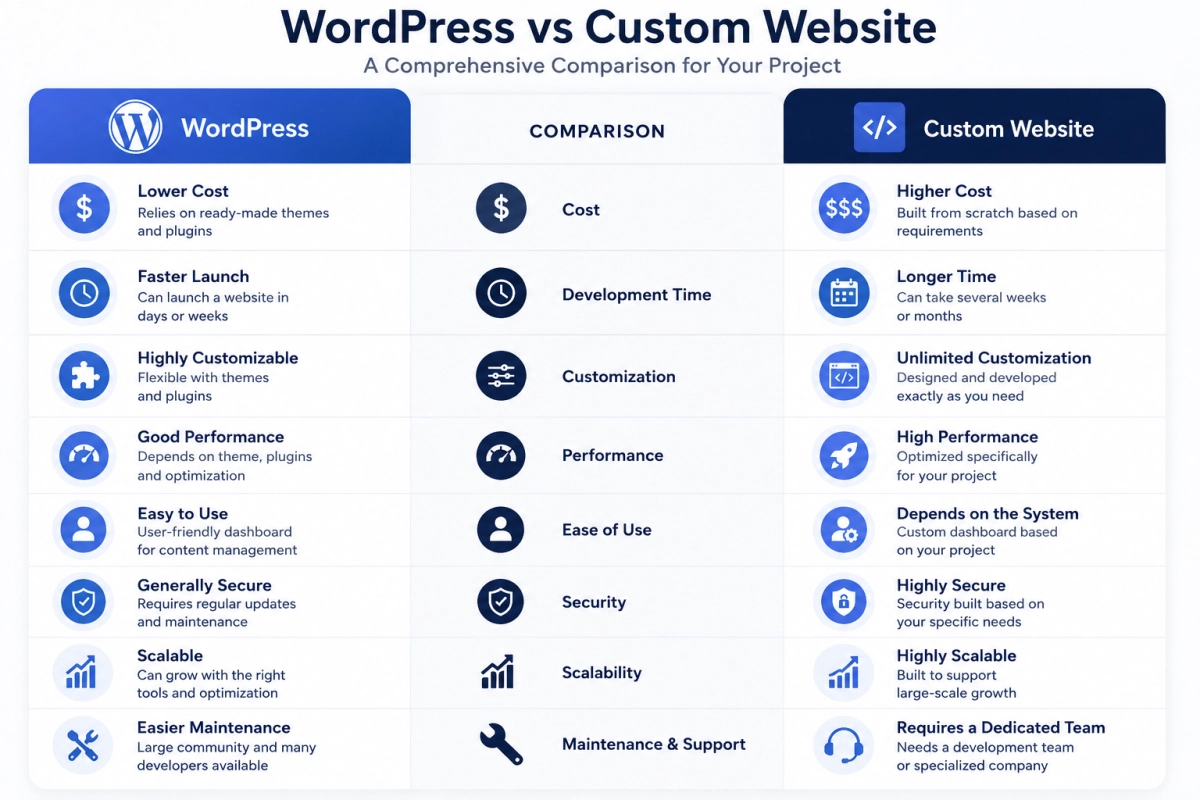
Direct Comparison
Cost
WordPress:
Low to moderate.
Custom Website:
Moderate to high.
Development Time
WordPress:
Typically weeks.
Custom Website:
Often several months.
Ease of Management
WordPress:
User-friendly.
Custom Website:
Depends on the system and dashboard design.
Customization
WordPress:
Highly flexible.
Custom Website:
Virtually unlimited.
Maintenance
WordPress:
Requires updates and plugin management.
Custom Website:
Requires ongoing technical support and development.
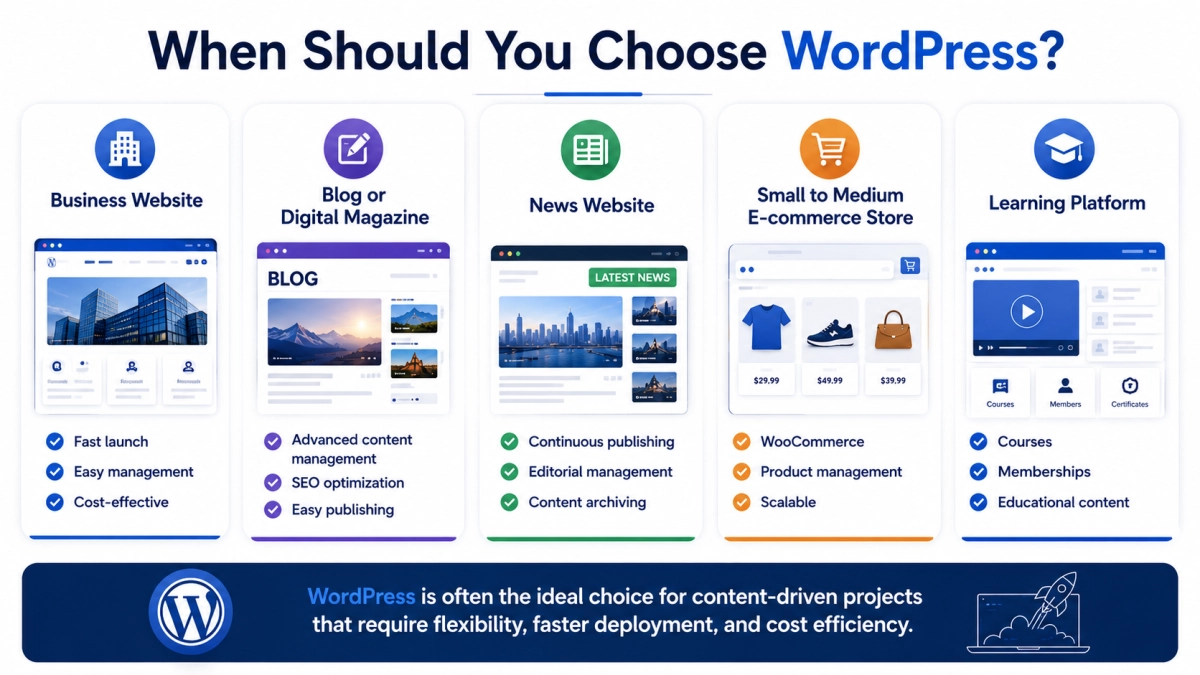
When Should You Choose WordPress?
WordPress is often the ideal solution for:
- Business websites.
- News websites.
- Professional blogs.
- Small and medium e-commerce stores.
- Content-driven platforms.
It is particularly attractive when budget, speed, and ease of management are priorities.
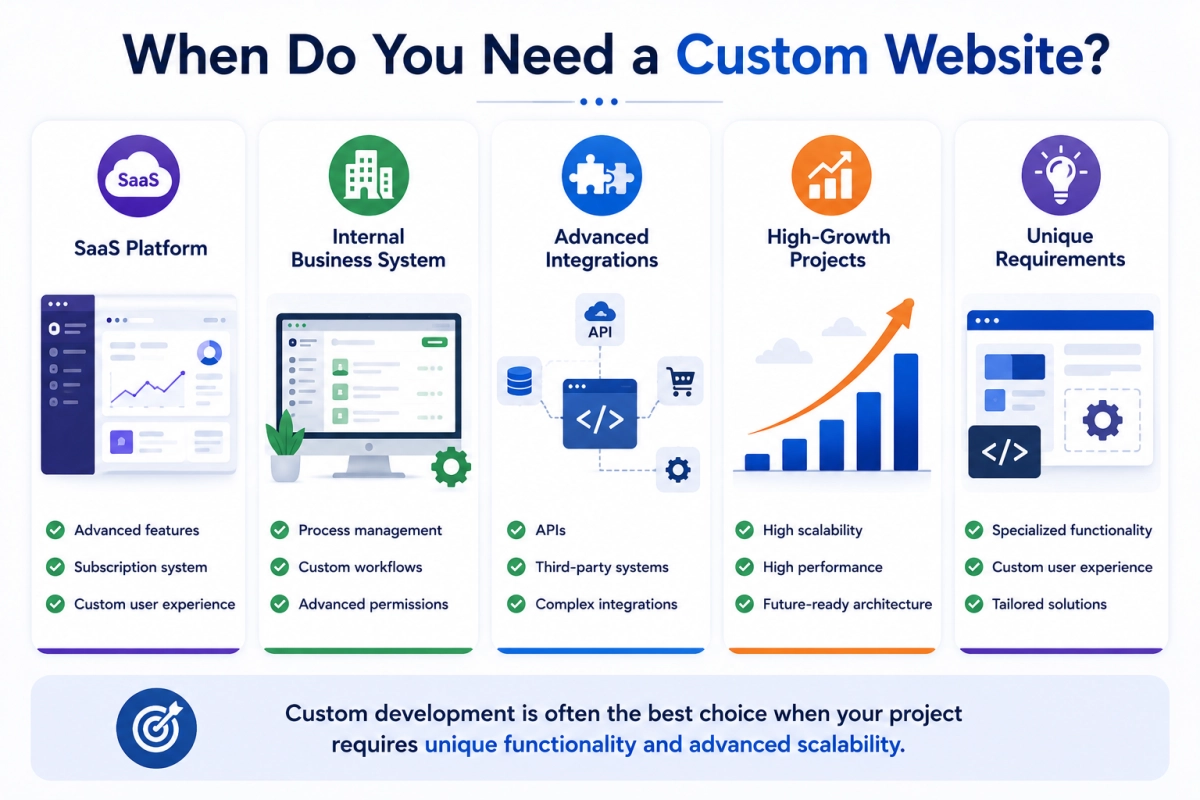
When Should You Choose a Custom Website?
Custom development is usually the better choice when a project requires:
- Unique functionality.
- SaaS platforms.
- Complex internal systems.
- Advanced integrations.
- Large-scale data processing.
- Specialized workflows.
Common Mistakes
Choosing Custom Development Only Because It Seems More Professional
Many projects spend money on complexity they do not actually need.
Choosing WordPress for Highly Specialized Requirements
Trying to force WordPress into scenarios it was not designed for can create challenges later.
Ignoring Future Growth
Technology decisions should consider both current and future requirements.
Focusing Only on Cost
The cheapest solution is not always the best, and the most expensive solution is not always necessary.
Final Verdict
There is no universal answer.
For many businesses, WordPress provides the best balance between cost, flexibility, scalability, and speed.
For others, custom development offers the control and functionality required to build highly specialized digital products.
The real question is not:
“Which one is better?”
The better question is:
“Which one is the best fit for my project’s goals, budget, and future growth?”
Making the decision based on those factors will significantly increase the chances of long-term success.